
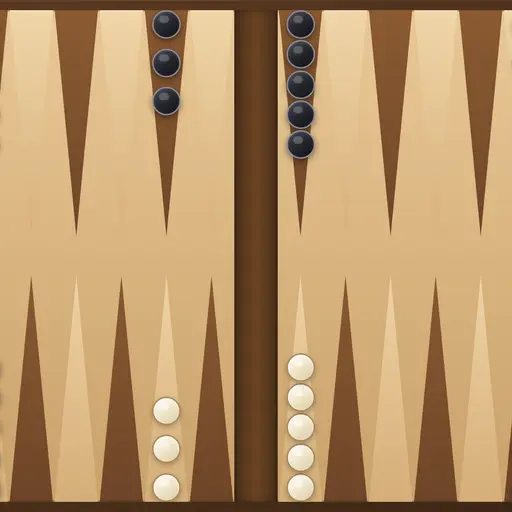
About Backgammon
Backgammon is the oldest race game still on every table — five thousand years of dice, daring, and comebacks. You race fifteen checkers around the board while your opponent runs the opposite way, and every roll is a fresh decision: play safe, or leave a shot and pay for it.
This board handles the rules that trip up beginners: legal moves light up for each roll, hits send blots to the bar, re-entry happens in the correct home board, and bearing off unlocks only when all your checkers are home. Play against four AI levels, share a screen with a friend, or open an online room and roll against someone real over an invite link.
Backgammon at a glance
- Origin
- Mesopotamia, ~3000 BCE; modern rules standardized in the 20th century
- Board
- 24 points across four quadrants, 15 checkers per side, two dice
- Players
- 2
- Modes here
- vs AI (4 levels), same-screen 2P, online friend rooms
- Learn more
- Wikipedia
How to play Backgammon
Each player races 15 checkers around 24 points in opposite directions. Roll two dice, move, and bear all your checkers off first to win.
- Move one checker per die, or one checker twice — a 3 and a 5 can move one checker 3 then 5, or two different checkers.
- Doubles play twice: rolling 4-4 gives you four moves of 4.
- A point with two or more enemy checkers is blocked. A lone enemy checker is a blot — land on it to hit it onto the bar.
- A checker on the bar must re-enter in the opponent's home board before you may move anything else.
- Once all fifteen of your checkers reach your home board, bear them off with your rolls. First player to remove all 15 wins.
Backgammon strategy tips
- Make points, not runs: two checkers together block the point and can never be hit.
- Prime the middle — several consecutive made points build a wall enemy checkers cannot cross.
- Hit when it hurts: sending a blot to the bar while your home board is strong can decide the game instantly.
- Count pips before choosing a plan. If you are ahead in the race, simplify and run; if behind, play a holding game and wait for a shot.
- Do not bury checkers on your 1 and 2 points early — flexibility wins more games than safety.
Backgammon FAQ
- Is backgammon a game of luck or skill?
- Both, by design. A single game swings on dice, but across many games the stronger player wins clearly — checker play, timing, and risk management compound. That mix is exactly why the game has survived five thousand years.
- What happens when my checker gets hit?
- It goes to the bar in the middle of the board. Before making any other move you must re-enter it in your opponent's home board on a die matching an open point — if every entry point is blocked, you lose the whole turn.
- How does bearing off work?
- Once all fifteen of your checkers are in your home board, each die removes a checker from the matching point. Higher rolls than your furthest checker bear off from the highest occupied point. If you get hit during bear-off, the checker must run the full circuit again.
- Can I play backgammon online with a friend on this site?
- Yes — open a room, send the link, and you both play the same live board with rolls and hits syncing in real time. It works in any browser with no account.
- Does the board stop me from making illegal moves?
- Yes. Only legal destinations light up for each die, forced entries from the bar are applied, and the maximum use of your roll is required — so you can focus on strategy instead of rulebook arguments.
Games like Backgammon
Roll the dice, make your points, and race home first — play backgammon free in your browser.