
About Dots and Boxes
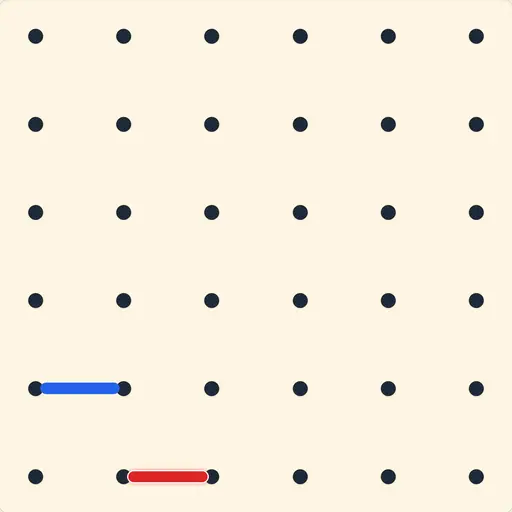
Dots and boxes is the pencil-and-paper duel everyone drew in a school notebook: take turns adding one line between dots, close the fourth side of a box to claim it, and go again. Published by the mathematician Édouard Lucas in 1889, it hides a genuinely deep combinatorial game behind that innocent grid.
Here the notebook is upgraded: play on 4×4, 5×5, or 6×6 grids with claimed boxes colored instantly and the bonus-turn rule handled for you. The four AI levels climb from casual doodling to chain-counting menace, same-screen mode covers recess-style duels, and online rooms let a friend join your grid from a link.
Dots and Boxes at a glance
- Origin
- Published by Édouard Lucas as 'la pipopipette', France, 1889
- Board
- 4×4, 5×5, or 6×6 boxes
- Players
- 2
- Modes here
- vs AI (4 levels), same-screen 2P, online friend rooms
- Learn more
- Wikipedia
How to play Dots and Boxes
Players alternate drawing one edge between two adjacent dots. Whoever closes more boxes wins.
- On your turn, draw a single horizontal or vertical line between two neighboring dots.
- Complete the fourth side of a 1×1 box and you claim it — it takes your color and you immediately move again.
- One line can close two boxes at once; you claim both and still go again.
- Chains are the engine: each box you close opens the next, so one careless line can hand over a whole row.
- When every line is drawn, the player with more boxes wins.
Dots and Boxes strategy tips
- Never draw the third side of a box without a plan — you are gift-wrapping it for your opponent.
- Count the chains before the giving phase starts: whoever is forced to open the first long chain usually loses.
- Learn the double-cross: leave the last two boxes of a chain unclaimed to force your opponent to open the next chain for you.
- Aim for an odd or even number of chains depending on who moves first — chain parity, not box count, decides expert games.
- Early moves matter: spread lines to control how the grid will eventually partition into chains.
Dots and Boxes FAQ
- Do I really get another turn after closing a box?
- Yes — completing a box always grants an immediate extra move, and closing two boxes with one line still only obliges you to move once more. Long chains of closures in a single turn are where games are won and lost.
- What is the double-cross strategy everyone mentions?
- Instead of greedily taking every box in a chain, you leave the last two and close them with one sacrificial line — forcing your opponent to open the next chain for you. Mastering this one idea beats most casual players permanently.
- Which grid size should I pick?
- 4×4 for quick games and learning chain basics, 5×5 for a balanced duel, and 6×6 when you want long chains and real endgame counting. The AI scales its punishment accordingly.
- Can I play dots and boxes online with a friend?
- Yes — open a room, send the link, and you both draw on the same live grid from any browser. Boxes color in real time and no one needs an account.
- Is there more skill here than it looks?
- Far more. Casual play is about not giving boxes away; expert play is about chain parity and controlled sacrifices. It is one of the simplest games that still gets serious mathematical attention.
Games like Dots and Boxes

One line at a time, until someone opens the wrong chain — play dots and boxes free.