
About Mancala
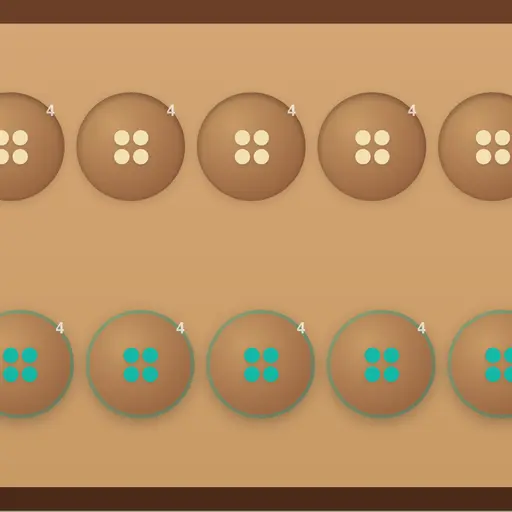
Mancala is a whole family of sowing games played for thousands of years across Africa and the Middle East — scoop up seeds, drop one in each pit around the board, and harvest more than your opponent. The version played here is Kalah, the modern standard: fully open information, no luck, and surprisingly deep counting under a calm surface.
The board sows seeds for you with a clean animation, awards extra turns when your last seed lands in your store, and applies cross-board captures automatically. Four AI levels go from teaching pace to genuinely sharp, two players can share one device, and online rooms let a friend join your game from a link.
Mancala at a glance
- Origin
- Sowing games are ancient across Africa and the Middle East; Kalah was published in the US in 1940
- Board
- 2×6 pits plus two stores, 48 seeds
- Players
- 2
- Modes here
- vs AI (4 levels), same-screen 2P, online friend rooms
- Learn more
- Wikipedia
How to play Mancala
Each player owns the six pits on their side plus the store on their right. Collect more seeds in your store than your opponent to win.
- On your turn, pick up all seeds from one of your six pits and sow them one per pit counter-clockwise, including your own store but skipping your opponent's store.
- If the last seed lands exactly in your store, you take another turn — chains of extra turns are the heart of Kalah.
- If the last seed lands in an empty pit on your side, you capture that seed plus every seed in the opposite pit on your opponent's side.
- When one player's six pits are all empty, the game ends and the other player sweeps their remaining seeds into their store.
- The player with more seeds banked wins; 24–24 is a draw.
Mancala strategy tips
- Learn the opening extra-turn chains: on the standard setup, starting from your third pit lands exactly in your store.
- Keep your rightmost pits stocked — they feed your store on short, safe sows.
- Count before you sow: an empty pit on your side is a capture threat your opponent can see too.
- Starve a loaded enemy pit by timing the endgame — forcing them to sow it into your side swings the count.
- Near the end, play so leftover seeds die on your side; the final sweep decides close games.
Mancala FAQ
- Which mancala rules does this board use?
- Kalah with four seeds per pit — the version most people mean by 'mancala' today. Landing your last seed in your store earns an extra turn, and ending in an empty pit on your side captures the opposite pit. Both rules are applied automatically.
- Is there any luck involved?
- None. Mancala is a perfect-information game like chess — every seed is visible and every outcome is calculable. If you lost, there was a better sow somewhere; the hint button can show you what you missed.
- How do captures work exactly?
- When the last seed of your sow lands in an empty pit on your own side, you take that seed plus all seeds in the directly opposite pit on your opponent's side. They all go to your store. Empty pits on your side are therefore both an opportunity and a warning sign.
- Can I play mancala online with a friend?
- Yes — open a room from this page and share the link. You both see the same live board with sows animating in real time, in any browser, no account required.
- Is mancala good for kids?
- Excellent — the rules are physical and intuitive, and the counting practice is real. Start them on the easy AI or play together in same-screen mode; games take about five minutes.
Games like Mancala

No dice, no hidden cards — just you, 48 seeds, and better counting. Play mancala free.