
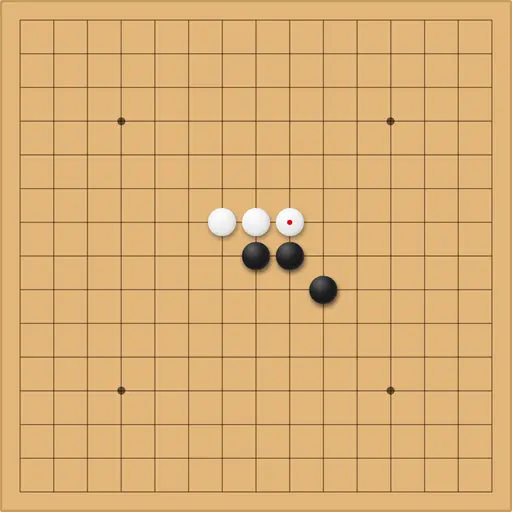
About Gomoku
Gomoku — also called five in a row — is the purest of the stone-placement games: take turns putting stones on the grid, and the first player to line up five of their color in any direction wins. It began on go equipment in East Asia and became a worldwide pen-and-paper classic because the rules take ten seconds to learn while the tactics stay genuinely sharp.
Here you play gomoku on a full 15×15 board with a clean, fast interface. The AI offers four levels — easy through master — and the top level actively builds double threats and blocks yours, so it is a real training partner. Prefer humans? Pass the device to a friend for the classic duel, or open an online room and play someone over a shared link with moves syncing live.
Gomoku at a glance
- Origin
- East Asia, played on go equipment for centuries; standardized in Japan as gomoku-narabe
- Board
- 15×15 intersections
- Players
- 2
- Modes here
- vs AI (4 levels), same-screen 2P, online friend rooms
- Learn more
- Wikipedia
How to play Gomoku
Black places the first stone, then players alternate one stone per turn on any empty intersection.
- Stones never move or get captured — the board only fills up, so every stone you place is permanent.
- Make a line of exactly five or more stones of your color — horizontal, vertical, or diagonal — to win on the spot.
- An open four (four in a row with both ends free) is unstoppable: your opponent can only block one end. Building one is usually the winning move.
- Watch for your opponent's open threes and fours — leaving an open three unanswered often loses the game a few moves later.
- If the board fills with no five in a row, the game is a draw.
Gomoku strategy tips
- Play your first stones near the center; lines have more room to grow there than at the edges.
- Attack with forcing moves: a four must be answered immediately, which lets you set up a second threat for free.
- The classic win is a double threat — two open threes, or a four plus a three — that cannot both be blocked.
- Defense counts as offense: a stone that blocks your opponent often extends one of your own lines. Look for those double-purpose moves.
- Don't chase a blocked line. Four stones with both ends sealed are dead weight — pivot to a fresh direction early.
Gomoku FAQ
- What is the difference between gomoku and five in a row?
- They are the same game — gomoku is the Japanese name and 'five in a row' is the English description. This board plays the freestyle version: any line of five or more of your stones wins, with no special opening restrictions.
- Is the master AI actually hard to beat?
- Yes. The top level recognizes open threes and fours, blocks your double threats, and builds its own. If you can beat master consistently, you are reading several moves deep — most players find hard challenging enough.
- Can two people play on one phone or computer?
- Yes. Switch to the same-device mode and take turns placing stones on one screen — the board tracks whose turn it is, exactly like playing on paper but with the win detected automatically.
- How do online gomoku rooms work?
- Open a room from the game page and share the link. Your friend joins the same live 15×15 board from any browser, moves appear in real time, and neither of you needs an account.
- Does first move give Black an unfair advantage?
- With perfect play Black does have a theoretical edge in freestyle gomoku — that is exactly why Connect6 was invented. In practice, at human level, sharp defense and double threats decide games long before opening theory does. If it bothers you, try Connect6 on this site.
Games like Gomoku

Ten seconds to learn, a lifetime to master — place your first stone and go for five in a row.