
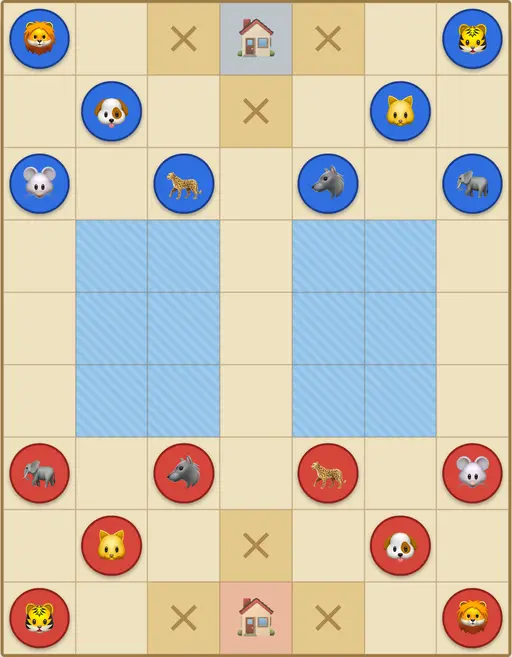
About Animal Chess
Animal chess — dou shou qi, the 'game of fighting beasts' — is the Chinese jungle classic where an elephant fears a rat and a rat can sink a lion's ambitions. Eight animals per side, each with a rank, battle across rivers and around baited traps toward the enemy den. It is beloved as a children's game in China, yet the trap-and-river tactics give adults plenty to chew on.
This board enforces the full jungle rulebook: rank-based captures, the rat-elephant exception, river swimming and lion-tiger leaps, and traps that drain defenders to zero. Play against four AI levels, share the screen with a kid or a friend, or open an online room and battle over an invite link.
Animal Chess at a glance
- Origin
- China, 20th century; known as dou shou qi, 'the game of fighting beasts'
- Board
- 7×9 grid with two rivers, six traps, and two dens
- Players
- 2
- Modes here
- vs AI (4 levels), same-screen 2P, online friend rooms
- Learn more
- Wikipedia
Animal chess pieces and ranks
Start with the red set below. Blue uses the same animals on a darker disc. Every piece steps one square orthogonally; a higher rank captures a lower one, except the rat can take the elephant.
How to play Animal Chess
Each side commands eight animals ranked from elephant (8) down to rat (1). Enter the enemy den — or capture every enemy animal — to win.
- Animals move one square horizontally or vertically. An animal captures any enemy of equal or lower rank.
- The great exception: the rat can capture the elephant, but the elephant cannot capture the rat.
- Only the rat may swim in the rivers; while in the water it cannot be captured from land, and it may not capture the elephant as it exits.
- The lion and tiger leap across a river in a straight line — unless a swimming rat blocks the path.
- Any enemy animal standing in a trap next to your den drops to rank zero, so even your rat can eat it. No animal may enter its own den.
Animal Chess strategy tips
- Your rat is a strategic weapon, not a throwaway — it checks the enemy elephant and blockades river leaps.
- Bait the traps: retreating a weak animal behind a trap square invites a stronger attacker into a free capture.
- Keep the lion and tiger mobile near the rivers; their leaps create den threats from surprising angles.
- Trade your elephant carefully — its worst enemy is the cheapest enemy piece on the board.
- The den wins the game, not the body count: a sneaky low-rank runner slips through while big animals brawl.
Animal Chess FAQ
- Why can the rat beat the elephant?
- Tradition says the rat crawls into the elephant's ear. Mechanically it is the rule that makes the whole game work: the strongest piece has a fatal weakness to the weakest, so no army corner of the board is ever completely safe.
- What do the traps do exactly?
- The three squares around each den are traps for the attacker: any enemy animal standing in one loses all rank, and any of your animals — even the rat — can capture it. Defended traps are the jungle's most reliable ambush.
- How do the rivers work?
- Only the rat can enter the water, where land animals cannot touch it. The lion and tiger can leap the river in a straight line to the far bank — but a rat swimming in the path blocks the jump, which is one of the game's key defensive tricks.
- Is animal chess just for kids?
- It is a brilliant kids' game — the animal ranks teach threat evaluation painlessly — but the trap baiting, river control, and den races give it real adult depth. The master AI will happily prove the point.
- Can I play animal chess online with a friend?
- Yes. Open a room from this page and send the link — both of you play the same live jungle from any browser, with every rank rule and trap enforced automatically.
Games like Animal Chess
Elephants, traps, and one very brave rat — play the jungle game free in your browser.