
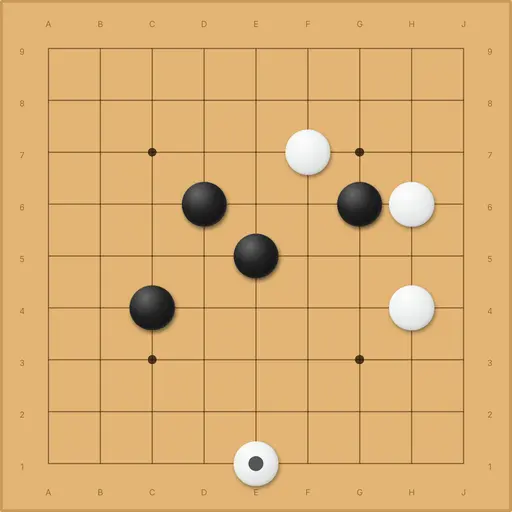
About Go
Go is the oldest board game still played in its original form — over 2,500 years of history built on one simple act: place a stone, surround territory. From those minimal rules emerges strategy deep enough that mastering it takes a lifetime, and beating strong humans was long considered AI's hardest board-game challenge.
FreePlayBase serves go on a 9×9 board, the size teachers recommend for learning: games finish in minutes and every stone matters. Captures, the ko rule, and Chinese area scoring with 7.5 komi are all handled automatically, so you can focus on shape and territory. Play against a Monte Carlo AI with four strength levels, share one screen with a friend, or open an online room and play a live game over an invite link.
Go at a glance
- Origin
- China, more than 2,500 years ago; spread through Korea and Japan
- Board
- 9×9 intersections here (19×19 is the traditional full size)
- Players
- 2
- Modes here
- vs AI (4 levels), same-screen 2P, online friend rooms
- Learn more
- Wikipedia
How to play Go
Black plays first. Players take turns placing one stone on an empty intersection, trying to surround more territory than the opponent.
- Stones are placed on line intersections, not squares, and never move once played — they can only be captured.
- A group's empty adjacent intersections are its liberties. When a group's last liberty is filled, it is captured and removed from the board.
- You may not recreate the previous board position — this is the ko rule, and the board will stop you from an illegal retake.
- Pass when you see no useful move left. Two passes in a row end the game.
- Scoring is Chinese area: your stones on the board plus the empty points only you surround. White receives 7.5 komi for moving second, so there are no ties.
Go strategy tips
- Corners first, then sides, then center — territory is cheapest where the board edge helps you fence it.
- Don't try to kill everything. Letting a small group live while you take profit elsewhere usually wins the game.
- Keep your groups connected and give them two eyes; a group with two eyes can never be captured.
- When a fight starts, count liberties before you commit — the side with more liberties usually wins the race.
- On 9×9 the game is short: every move should either grow your territory or shrink your opponent's.
Go FAQ
- Why is the board 9×9 instead of the full 19×19?
- 9×9 is the standard teaching size: the same rules apply, but games take minutes instead of an hour, and tactical lessons come up constantly. It is the fastest way to actually get better at go, whether you are brand new or sharpening your close fighting.
- How does scoring work at the end of a game?
- The board uses Chinese area scoring: your score is the number of your stones on the board plus the empty intersections that only your stones surround. White gets an extra 7.5 points of komi as compensation for moving second, which also means a game can never end in a tie.
- Do I have to spot captures and ko violations myself?
- No. The board removes captured groups automatically, blocks illegal ko retakes, and counts the final score for you. You only have to think about where the next stone goes.
- Can I play go online with a friend on this site?
- Yes. Open an online room from the go page and send the link — your friend joins the same live board in their browser, no account or app required.
- Is the AI worth playing for a beginner?
- Yes. The Monte Carlo engine has four levels; easy plays loosely enough for first games, and master will punish overextended groups. Undo and hints are available whenever it is your turn.
Games like Go
Place the first stone and see why go has held players for 2,500 years — free, right in your browser.