
How to Think in Nine Men's Morris
Strong mill play is less about memorising coordinates and more about reading phases: who controls the junctions, who can re-form a mill, and which capture actually reduces the opponent's options.
Ask: “If they make a mill next turn, which stone do I lose — and can I still block their follow-up?”
Own junctions where several lines meet
A stone on a junction belongs to more mills at once. The mid-side points of the outer square are classic examples: from there you can threaten lines on two sides and along the radial link. Early placement on junctions buys flexibility; corners are easier to isolate.
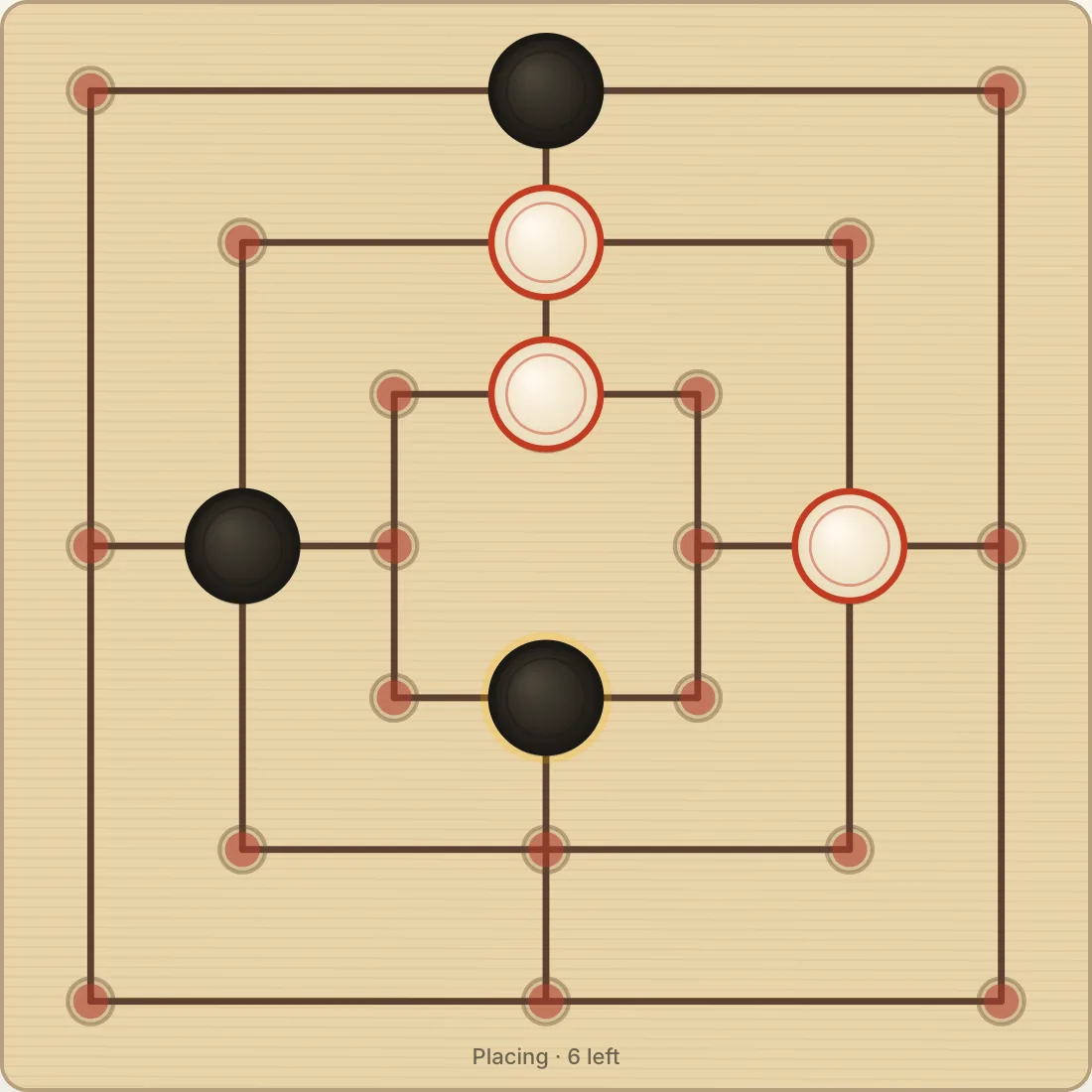
Threaten two mills when you can
The cleanest advantage is a double threat: one move that could complete a mill on two different lines. Your opponent may block one, but often cannot stop both. While setting this up, look for a broken mill you can re-open next turn — a recurring capture is stronger than a one-off mill.
Remove the stone that limits them most
When you must capture, do not grab the first stone that is legal. Remove a junction stone that sits in two potential mills, or a piece that blocks your own mill re-formation. If every enemy stone is in a mill, take the one whose loss opens the most lines for you on the next turn.
Shift gears when the phase changes
During placement, prioritise structure over instant mills — a cheap mill that scatters your stones can backfire. Once movement starts, mobility wins: keep at least two stones free to slide. At three stones, flying turns empty points into threats; plan two jumps ahead so your mill lands while theirs breaks.
Three mistakes that hand over games
- Forming an early mill that pulls your stones away from the junctions you need later.
- Removing a corner stone while leaving an enemy junction untouched.
- Sliding into a line you cannot re-form, while the opponent still has a double mill threat.
Nine Men's Morris strategy questions
- Should I always take a mill in the opening?
- Not if it weakens your position on the junctions. A mill that costs you central presence can give the opponent the next two captures through better structure.
- What is a double mill threat?
- It is a position where your next placement or slide could complete a mill on two different lines. The opponent can block only one line, so you still get a capture or a winning follow-up.
- Which capture is best when several are legal?
- Prefer stones on junctions, stones that sit in multiple mills, or stones that stop you from re-forming your own mill. Avoid captures that leave the opponent mobile with no loss of threats.
- How do I improve fastest?
- After each loss, find the first turn where you ignored a double threat or removed the wrong stone. Replay that moment against the AI — one habit at a time beats memorising coordinates.
Try one idea at a time
Play against the computer and spend a game watching only junction control. In the next game, focus on capture choice after each mill. You do not need to see every line at once.