
Nine Men's Morris Rules
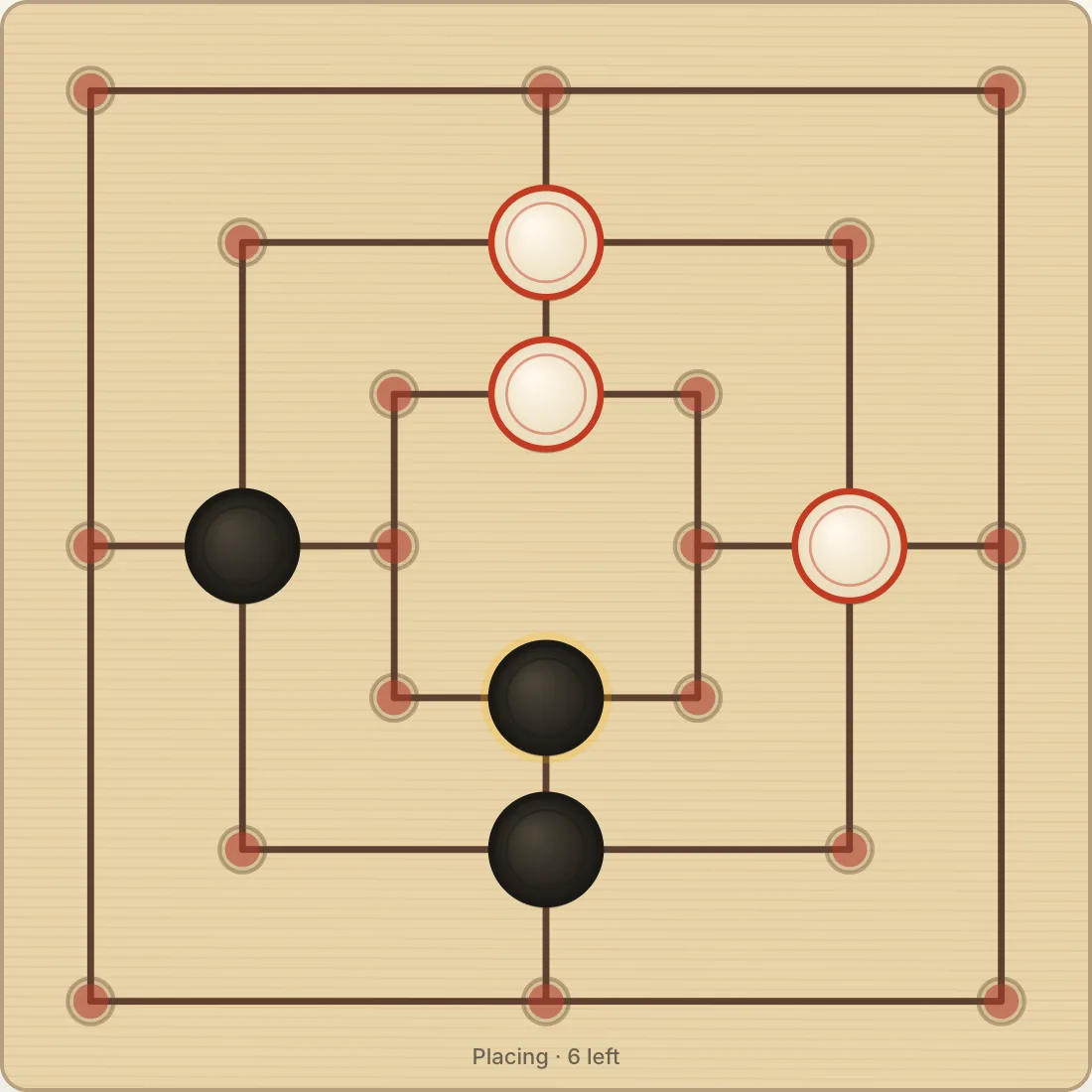
Nine Men's Morris is played on a board of 24 points linked by three nested squares. Each player places nine stones, forms mills to remove enemy pieces, then slides — or flies — until one side is reduced or blocked.
What you need to know before the first stone
- Two players; each side has nine stones.
- The board has 24 intersection points connected by straight lines.
- White places first on this FreePlayBase board.
- The game has three phases: placement, movement, and flying (when down to three stones).
The placement phase
- On your turn, put one stone on any empty point.
- Alternate until both players have placed all nine stones.
- If your placement completes a mill, remove an opponent stone before the turn ends.
- When the last stone is placed, the movement phase begins.
During placement you cannot slide stones yet — only add new ones. Mills formed while placing still trigger an immediate capture.
Mills and removal
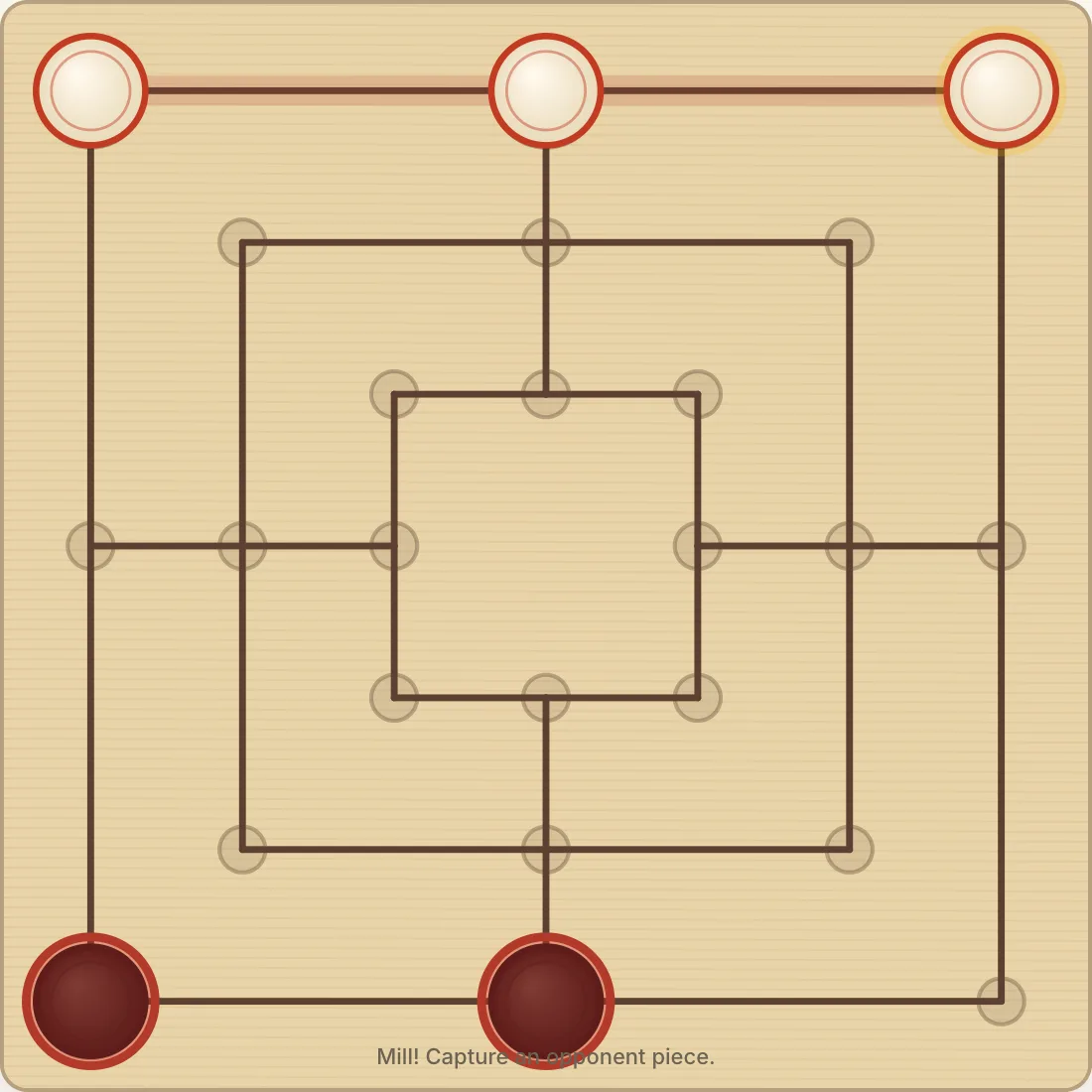
Whenever you make three of your stones in a straight line, you have formed a mill. You must immediately remove one enemy stone that is not in a mill, unless every enemy stone is in a mill — then you may remove any one of them.
A mill can be broken and re-formed later. Re-opening a mill on your next turn creates another capture, which is why mill re-formation is central to the game.
Movement and flying
Once all stones are on the board, you slide one stone along a line to an adjacent empty point. Mills still capture the same way during movement.
When you have exactly three stones left, your stones may jump to any empty point on the board on your turn instead of sliding one step. That flying rule makes endgames sharp and mobile.
How you win
You win if the opponent has fewer than three stones on the board, or if it is their turn and they cannot make a legal move. Reducing mobility is as important as capturing stones.
How Nine Men's Morris differs from simpler line games
Tic-tac-toe asks for three in a row on a small grid with no captures. Nine Men's Morris adds a larger graph, mill captures, and a sliding endgame where blocking lines matters as much as making them.
For another capture-heavy board game, try Checkers. For open line-building without mills, see Gomoku.
Nine Men's Morris rules FAQ
- What counts as a mill in Nine Men's Morris?
- A mill is three of your stones in a straight line along the board graph — on an outer, middle, or inner side, or along one of the mid-side links. Completing a mill on your turn lets you remove one opponent stone immediately.
- Which opponent stone can I remove after a mill?
- You must remove a stone that is not currently in a mill, unless every enemy stone on the board is part of a mill. In that case you may remove any enemy stone.
- When do stones start flying to any empty point?
- After the placement phase ends, if you have exactly three stones left on the board, each of your moves may jump to any empty point instead of sliding to an adjacent one. That is the flying phase.
- Can I move a stone that is already in a mill?
- Yes, during the movement or flying phase you may slide or jump any of your stones, including ones that sit in a mill. Breaking your own mill is often part of setting up a mill you can re-form on the next turn.
- How do you win Nine Men's Morris?
- You win when the opponent has fewer than three stones on the board, or when it is their turn and they have no legal move. There is no draw once placement is finished.
Practice the rules on a live board
The board enforces legal placement, mill captures, sliding, and flying for you. Play against the computer, pass one device between two players, or open a friend room when you are ready to test the full cycle.
Ready to move beyond the rules? Learn practical strategy →